From Promise to Impact: A Practical Framework for More Effective EdTech Adoption & Integration
As schools and institutions adopt a wide range of education technology tools and platforms, the impacts on learning don’t always live up to the promise, giving rise to growing public skepticism about the real value of EdTech investments. Often, however, the challenges are not inherent to the tools themselves but in how they are integrated into instruction. This post offers EdTech developers, educators, and education grant seekers a clear, step-by-step framework for aligning technology adoption and implementation efforts with best practices in instruction, capacity building, and change leadership — to ensure that EdTech adoptions fit into strong and sustainable learning designs and help drive meaningful learning outcomes.

I. The Current Landscape: Why EdTech Skepticism Is on the Rise
Across K–12 systems, higher education, and workforce training environments, access to digital tools has expanded rapidly over the past decade. At the same time, questions about impact have become more pronounced:
Research findings are mixed.
A growing chorus of skeptics are focusing on reports that more EdTech use correlates with less learning.
General findings about the impact of “screen time” and the use or overuse of “personal devices” suggest digital distractions are fragmenting student attention, undermining teacher-student rapport, and leading to learning declines, not gains.
Proving empirically what’s impacting learning or hindering it across diverse settings is far from easy. That said, current headlines are not trending positively when it comes to public perceptions about the impact of education technologies — posing a growing challenge for EdTech teams and for school leaders seeking return on EdTech investments or otherwise hoping EdTech can help them overcome long-standing instructional challenges.
The title of a recent article in The Economist (Jan. 2026) — ”EdTech is profitable, it is also mostly useless”— highlights the mounting doubts. The authors assert that even while EdTech companies advertise significant learning gains, “independent research has made clear that technology rarely boosts learning in schools — and often impairs it.”
Other studies both muddy the waters and add an additional layer of bad press, by focusing not on instructional technologies as such, but on the impacts all varieties of personal devices are having on learning — highlighting how access to digital platforms such as video games, social media, and smartphone apps, are impeding learning.
For example, The National Institutes of Health published findings from a meta-analysis on the effects such technology factors have on learning, concluding that “increased use of these personal technologies was associated with poorer academic outcomes, potentially impacting key cognitive skills essential for academic success.”
While skeptics are casting a wide and not overly empirical net at the moment, not to mention that there are many examples of successful integration, the fact remains that EdTech adoptions are not delivering returns comensurate with the investments being made.
The culprit is likely to be found in many of the complex challenges that educators have struggled with for decades. This means that even if the root of the issue often isn't the technology itself — the risks are still significant. We are now seeing the degree to which device-laden classrooms and lifestyles are amplifying factors that inhibit learning all while instructional technologies can only potentially support and accelerate learning — but only if adoption results in coherent integration into strong learning cultures and designs.
We are now seeing the degree to which device-laden classrooms and lifestyles are amplifying factors that inhibit learning all while instructional technologies can only potentially support and accelerate learning — but only if adoption results in coherent integration into strong learning cultures and designs.
When tools are layered onto loosely designed or ineffective instructional routines, or integrated without sufficient support for educators, they are likely to add complexity, distraction, or fragmentation rather than improve and accelerate learning.
Despite this, education leaders have too often relied on a solutions-first posture when adopting EdTech tools — looking for a shortcut for resolving stubborn learning gaps and challenges — instead of integrating EdTech tools in ways that strengthen and extend already strong instructional designs.
Once educators realize that EdTech investments rarely fix learning gaps or declines on their own and are more likely to amplify already existing instructional practices — both the effective and ineffective ones — then the potential promises, limitations, and risks of investing in education technologies come into clearer focus.
Integrating EdTech solutions into weak learning designs is not only likely to deliver lackluster results but can even exacerbate learning declines — raising the stakes when it comes to relying on EdTech in the first place.
Once educators realize that EdTech investments rarely fix learning gaps or declines and are more likely to amplify already existing instructional practices — both the effective and ineffective ones — then the potential promises, limitations, and risks come into clearer focus.
The persistent difficulty of maintaining high-quality instruction that adapts to evolving societal shifts and workplace demands is mirrored in the disconnect between EdTech procurement and its successful implementation. This disparity — where technology usage fails due to unresolved instructional gaps — remains a primary obstacle for educators and technology vendors alike. Increasingly visible to the public, this challenge now threatens the fundamental potential of educational technology in schools.
II. Getting From Promise to Impact: A Holistic Approach Is Required
To turn EdTech investments into meaningful learning gains, it’s crucial to start with a solid and holistic instructional framework, and ensure that digital tools and features serve defined purposes directly aligned with learning objectives:
to amplify student agency
to enlarge access to relevant knowledge and skills
to optimize instructional time and coherence
to enhance meaningful student engagement and critical thinking
A Holistic Framework for EdTech Integration
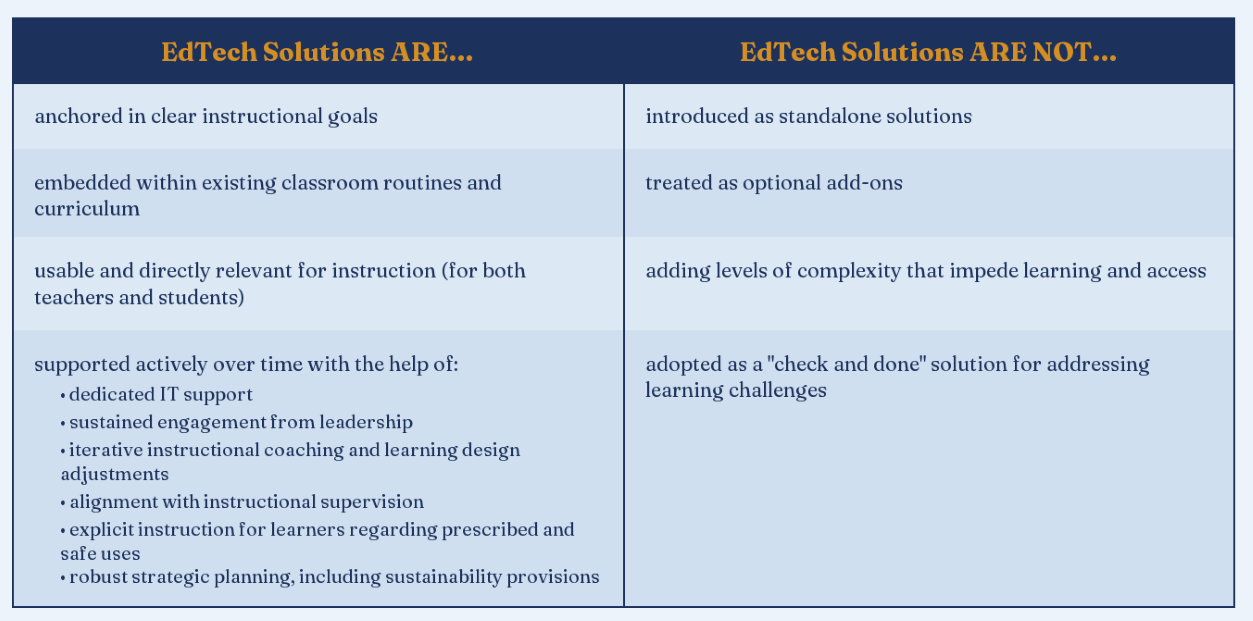

With this kind of holistic integration, EdTech adoptions are almost always less visible as a separate instructional initiative and more integrated into the fabric of the local teaching framework.
The focus shifts away from the tools themselves and toward the quality and coherence of the instructional experience they support.
The question, then, is not simply which tools to adopt, but how to structure implementation so that technology reinforces learning rather than fragmenting it.
III. A Step-by-Step Framework for Effective EdTech Adoption
To translate access to instructional technology into meaningful learning outcomes, schools need a clear sequence of design and implementation decisions.
The framework below outlines a step-by-step guide to a coherent, change-driven approach aligned with best practices that support effective learning designs, cultures, and systems.
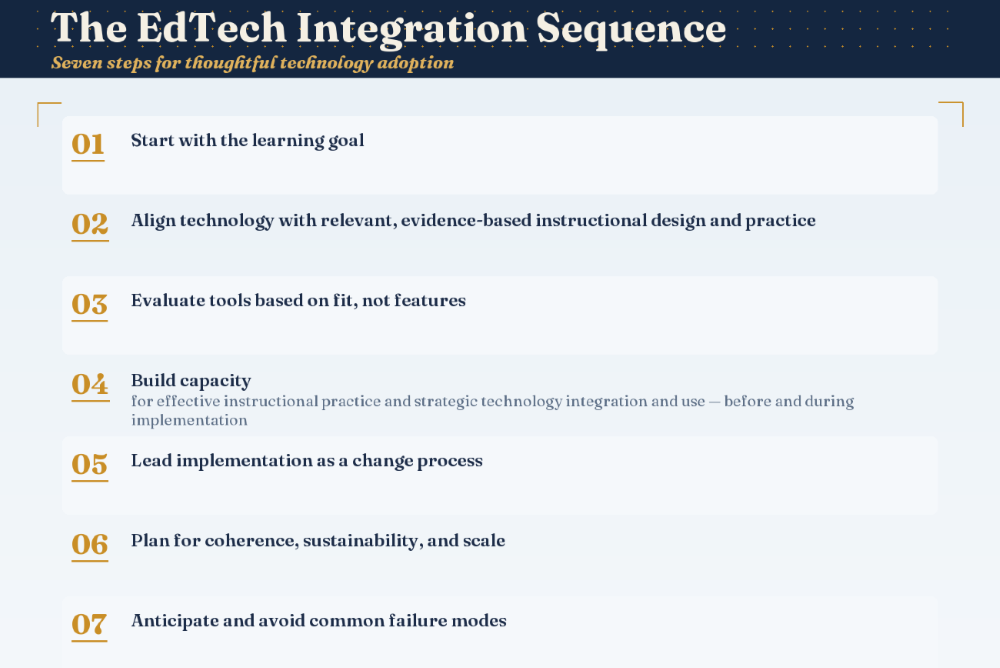
Step 1. Start with the Learning Goal (Not the Tool)
Effective learning does not start with selecting technology. It begins with clarity about
coherent curriculum design practices — such as teaching by design and backwards planning with a focus on enduring and relevant learning objectives, 21st-century skills, and progressions from lower-order to higher-order skills and mastery
evidence-backed learning methods and approaches — rooted in cognitive science and inquiry-based learning
the payback that comes from sustained investments in social capital — building shared understanding among organizational or system stakeholders around how to pursue these goals and supporting professional inquiry and learning alongside student inquiry and learning
Without this clarity, technology adoption tends to default to convenience or novelty — tools are selected based on features before anyone knows which features or capacities are relevant, turning learning technologies into drivers of distraction, dilution, fragmentation, and unnecessary added complexity.
When education decisions are aligned with a solid instructional framework and systems approach, technology decisions become more focused and defensible — remaining clearly aligned with the pursuit of improving instructional quality and outcomes.
Expert Tip: Anchor Technology in Learning Quality, Not Efficiency Alone
When technology is framed primarily as a way to scale instruction or reduce costs, stakeholders may question its impact on quality. Maintaining an explicit and laser focus on learning goals, content relevance, high expectations, and well sequenced instructional designs helps maintain credibility and alignment for all stakeholders.
Step 2. Align Technology with Instructional Design and Practice
Technology is most effective when it is integrated into existing instructional routines or used to support clearly defined improvements to those routines, and not added on, like an external or supplemental accessory.
When digital tools aren’t well integrated and operate in parallel to core instruction — used occasionally, inconsistently, or as enrichment — they are less likely to have a meaningful impact on core learning and may even detract from other more effective instructional strategies, formats, and uses of time.
“Technology can provide benefits in helping enable better learning outcomes as part of effective technology-enabled instructional practices — not simply on its own.”
— “Strategies for Encouraging Effective Technology-Enabled Instructional Practices in K–12 Education: A Thought Piece Drawing on Research and Practice.” WestEd (published 2023; accessed 28 April, 2026)
Furthermore, applying digital tools to poorly organized teaching methods often increases incoherence and may supplant more genuine teacher-led efforts with highly stimulating but mostly superficial sensory features.
For effective integration, educators should focus on the following priorities:
incorporating tools into daily or weekly instructional routines primarily or exclusively in ways that directly support larger instructional routines, formats, and structures
ensuring a coherent fit within core instructional sequences
prioritizing software applications that retain a strong focus core learning objectives while enabling deeper learning, engagement, or collaboration
Expert Tip: Prioritize Active Engagement Over Mere Task Fulfillment
Learning may be compromised when EdTech is employed to bypass critical effort rather than stimulate thought. By integrating technology into learning projects that necessitate reasoning, implementation, and analysis, educators can ensure that technology extends — not replaces — mental efforts that drive deeper learning and mastery.
In practice, this often means simplifying rather than expanding the toolset, and designing for consistency and continuity, so that both teachers and students can focus attention on learning rather than navigating multiple and fragmented instructional inputs.
Step 3. Evaluate Tools Using Clear, Instruction-Aligned Criteria
Technology selection should be guided by how well a tool fits the instructional context, not by the number or novelty of its features.
Key considerations for vetting suitable EdTech options include:
evaluating how EdTech tools increase access to core content and/or to extended learning
adopting tools with a specific focus on adaptive learning features, such as enhancing learners’ access to targeted practice and personalized remediation needs, in close alignment with core skills and knowledge
ensuring streamlined usability for both teachers and students and compatibility with existing systems, infrastructure, and workflows
prioritizing features that will enhance feedback, practice, and assessment routines
integrating applications that help students build authentic workplace softskills
Tools that appear powerful in isolation can introduce friction when they are difficult to use, poorly integrated, or misaligned with classroom practice. Conversely, simpler tools that fit well within existing systems often produce more consistent results and advance and scale with less implementation risks.
Expert Tip: Apply a List of Reliable Standards When Vetting EdTech Tools
A tool may be polished and well-designed, yet still miss the mark if it doesn’t match the curriculum, lesson structure, or students’ needs. Be sure to check how well tools align with your instructional setting and with more universal evidence- and science-based learning designs, not just vendor promises or feature lists.
Step 4. Build Capacity Before and During Implementation
Even well-designed tools and plans depend on the people responsible for using them. Capacity building is therefore a central component of effective integration.
This includes:
ongoing professional learning that is embedded in instructional practice
opportunities for collaboration, reflection, and refinement
clear expectations for how and when tools will be used
support structures for troubleshooting and adaptation to achieve sustained, high-impact integration
Professional learning should entail an iterative and adaptive approach, qualified coaches who have the trust of the instructional teams, and robust and candid communication channels between leaders and stakeholders.
When evaluating best practices, prioritize those that help make instruction
effective — aligned to key learning objectives and supporting deeper assimilation and mastery
engaging — sparking intrinsic interest, maintaining relevance, and offering learners agency and voice
sustainable — feasible to implement over time, reinforcing coherent instruction without adding unnecessary workload or fragmentation
Step 5. Integrate EdTech Implementation Within Larger Change Processes
Integrating technology into instruction often requires shifts in practice, routines, and expectations. As a result, implementation should be approached as a process of organizational change rather than a simple rollout.
Effective systems-driven approaches to instructional change include:
inclusive management practices
aligning priorities across leadership teams and departments
safeguarding and investing in core organizational priorities (avoiding initiative overload and strategic drift)
pacing and aligning implementation steps with capacity growth and professional development support
enforcing norms for system-wide accountability — for leadership, instructional leads and staff, and students
communicating clear goals and rationales
monitoring progress, responding to stakeholder concerns, and making adjustments based on feedback and aligned with shared goals and priorities

Expert Tip:
Resistance often stems from concerns that technology will replace teachers or dilute instructional quality.
Clear communication about how tools are intended to support, and not replace, professional judgment can reduce friction and ensure a foundation of trust.
Without this level of coordination, EdTech integration often exacerbates resistance to change instead of advancing constructive and effective teamwork and sustained capacity building.
Step 6. Plan for Coherence, Sustainability, and Scale
Long-term impact depends on how well digital tools and practices are used and integrated organizationally too — how well they complement the organization’s values, culture, professional expertise, and instructional approaches.
Planning should address:
how tools connect across subjects, grade levels, and programs
how data and assessment practices are aligned
how funding will support maintenance, upgrades, and staffing
how systems will remain manageable for educators over time and support their evolving educational values and mission
Expert Tip: Plan for Privacy and Security From the Start
Data privacy, platform security, and responsible use policies are not add-ons. Addressing them early helps prevent disruptions and builds confidence among educators, students, and families. Efforts that begin as isolated pilots often struggle to scale when these considerations are not addressed early.
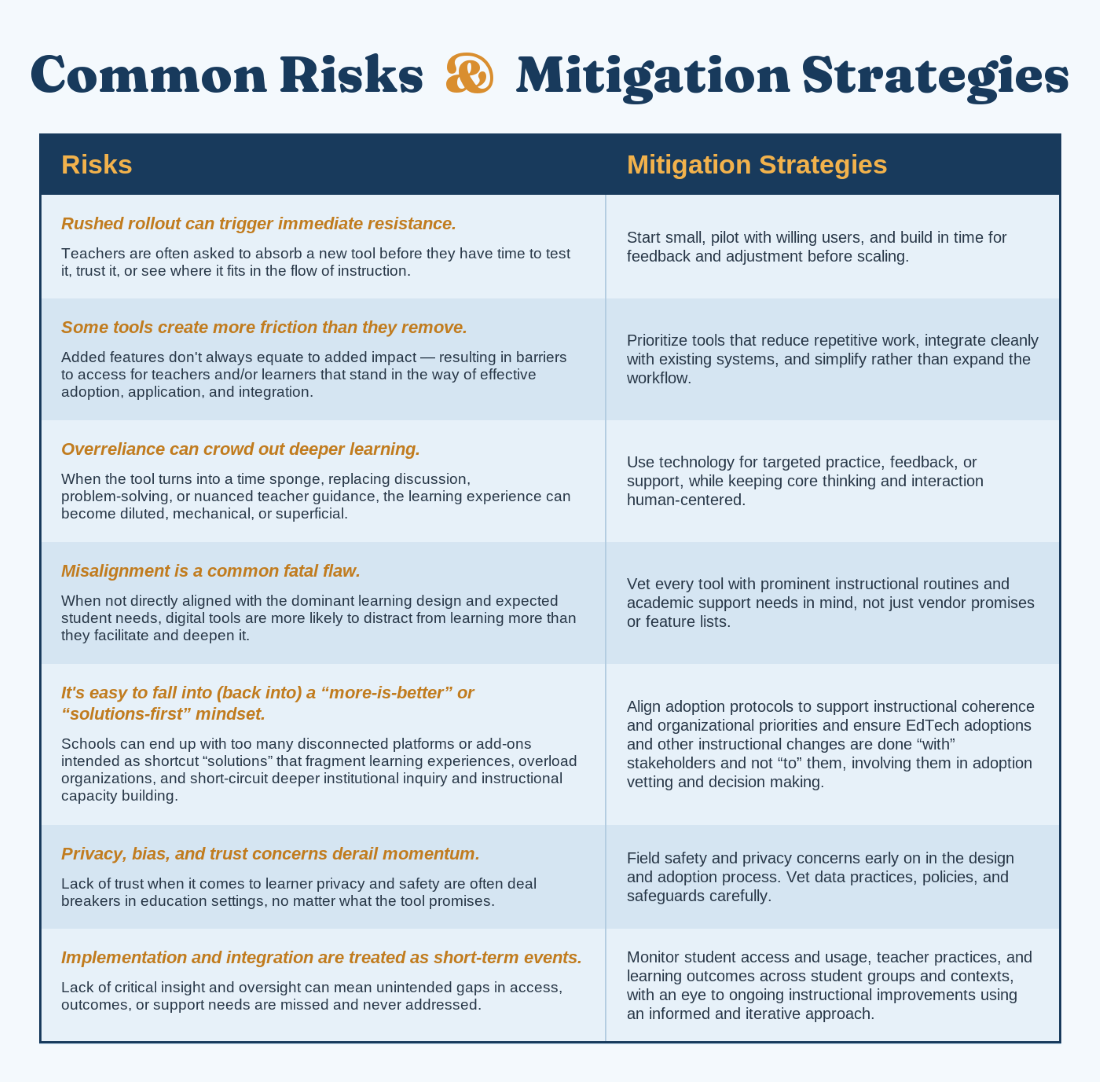
Step 7. What To Anticipate and What To Avoid When Adopting and Integrating Instructional Technology Tools
When adoptions grow out of distributed decision making, attention to instructional alignment and design, and careful and reliable vetting of EdTech options, then leaders and EdTech vendors will have an easier time when it comes to overcoming resistance, demonstrating how EdTech tools will amplify learning, and avoiding pitfalls that sabotage progress and feed deeper doubts about whether EdTech can really advance learning.
However, even with a thoughtful approach, the implementation path can easily present a range of organizational challenges — challenges that can fuel resistance, overload teachers, prevent consistent use, or dilute impact.
Addressing these risks proactively is crucial for keeping inevitable rough patches on the journey from fully derailing well-intentioned efforts.
Final Thoughts on Instructional Technology Integration — For Educators, EdTech Teams, and for Strategic Proposal Writing
Expanding access to digital tools has been one of the defining shifts in education over the past decade, but increased investments in instructional technologies are now accompanied by signs of mounting skepticism.
But access alone was never a recipe for meaningful outcomes.
The impact of EdTech depends far less on the tools themselves than on how they are integrated into coherent instructional systems.
When technology adoptions are aligned with clear learning goals, embedded in strong instructional routines, and supported through sustained and inclusive capacity building and engaged leadership, they can extend what is possible in teaching and learning — improving access, strengthening feedback loops, and supporting more flexible and responsive instruction.
When the right conditions are not in place, however, EdTech tools can introduce fragmentation, increase cognitive load, and dilute the quality of learning experiences.
For education leaders, EdTech teams, and organizations pursuing funding, the central challenge is not simply identifying promising tools, but designing the conditions under which those tools can support meaningful learning.
This requires clarity of purpose, disciplined implementation, and a sustained focus on instructional quality.
In the end, effective EdTech integration comes with no plug-and-play recipe for success.
The right approach and challenges will differ by context but remain governed by proven best practices, with EdTech tools empowering but not replacing the pivotal role of skilled and qualified education professionals — their unique visions, responsive instructional designs, and nuanced interventions — all imbued by the many variables at play across diverse learning settings and processes.