
“Everyone should have a say in the future of a technology built to enhance human intelligence and achievement, and if the feedback so far is any indicator, more of this kind of participation will make a significant difference to the kids currently in school and facing a rapidly changing future."
— Shannon Edwards, Chair, AI Subcommittee of the Data Privacy Working Group, New York City Public Schools
Can AI Councils Help School Leaders Build Consensus for AI Adoption and Practices?
The debate over AI in education often gets stuck between two positions: embrace it or ban it. Neither provides an adequate framework for the decisions schools and universities now face.
These extremes are likely to fuel polarization rather than collective effort. Taking a black and white approach also discounts the many conflicting and nuanced viewpoints that are emerging in public discourse around the value of AI and when and why it’s use is appropriate, or not, and by whom.
AI is poised to disrupt both how we learn, what we most need to learn, and it will shape the future of work and workplace skills. Now more than ever we need to build inclusion and consensus.
Some will say that all of this is ultimately “nothing new” for schools — as information-age educators are now familiar with the process of adopting and implementing evolving technologies.
But what about the work of building trust — especially when the use of technology in classrooms is the target of rising scrutiny and AI itself is so controversial? This is where AI councils can help, and no doubt why they’re emerging across the education landscape.
After all, how can there be effective and durable implementation in learning settings (or work settings for that matter) without inclusion and dialogue that will foster shared interests and goals across an organization, both horizontally and vertically?
“AI presents an unusual policy challenge because both the technology and public opinion continue to evolve quickly.”
— Bree Dusseault & Dana Harrison, writing for The 74, 27 Oct, 2026
Prescriptive, top-down actions will take a toll on school cultures and student learning.
Adoptions without consultation and all-out bans on AI and technology-infused teaching and learning don’t signal a rational or inclusive approach.
Neither of these extremes will allow school leaders to unite stakeholders around key initiatives for change and improvement.
Both extremes undermine efforts to encourage the kinds of open dialogue and inquiry that inform best practices and help schools flex and tone the adaptive muscles they need — to embrace innovation; to avoid getting entrenched in polarizing culture wars and dogmatic agendas.
Banning AI outright will conflict with the educational mission if it leaves students unprepared for a world in which AI reshapes work, innovation, and everyday life.
Racing to adopt AI too quickly carries its own risks. Schools need safeguards, opportunities to test and learn, and inclusive dialogue that builds trust and shared understanding around key values and how educators and students interact with AI. Otherwise, adoption can outpace the community’s chance to weigh competing hopes and concerns — from AI’s potential impacts on both job readiness and future job losses, and issues as urgent as student safety and data security.
These tensions deserve to be aired and need a place in the process of change leadership. Obviously, even if there’s a strong case that preparing for an AI future is essential, it doesn’t mean that all stakeholders will endorse AI equally.
As Gregory Faulkner found out in his role as Chair of the Panel for Educational Policy with New York City Schools, the question of how leaders move to integrate AI responsibly in school settings can spark significant public interest.
Purpose-driven AI adoption will mean taking on crucial adaptive challenges.
Neither banning AI nor rooting for adoption will allow educators opportunities to explore and debate where it belongs, whose interests it serves, or what safeguards it needs.
Those questions demand informed and constructive deliberation — and a meaningful place at the table for the people affected by the answers.
AI councils offer a core structure for doing this very work.
By bringing different kinds of expertise, experiences, and perspectives into the conversation, AI councils can help institutions determine whether, where, and under what conditions AI should be used.
The urgency is to establish that process before the adoption horse and technical tasks gets ahead of the change wagon — ahead of the adaptive pressures today’s AI transformations will unleash.
In this post, we’ll take a close look at the emergence of AI councils in education settings, what they are, how they work, and how they’re likely to affect what are already diffuse and layered decision making and budgeting processes informing what gets adopted and in what time frame and whether implementation is supported and left to wither.
1. What Are AI Councils in Education?
AI councils bring together people from across an institution or education community to guide decisions about AI. In this sense AI councils create a unique space — the convening center dedicated to collecting, engaging, and responding to the input of stakeholders over a sustained time period. This provides a focal point for building trust, eliciting input, taking the temperature of the institution as AI planning and adoption goals are formulated.
It’s also a vehicle for information sharing, for fostering transparency, and to bake accountability into the process from early on.
Common AI council mandates vary by institution of course, and based on how, and what pace, they evolve. Common roles and functions for AI councils include:
developing guiding principles for AI adoption and for AI use
recommending AI-related school policies
assessing proposed uses through diverse lenses, such as data security, student safety, and pedagogical best practices
helping ensure there’s coordination related to training needs, funding capacity, and infrastructure needs
Some differences will also depend, naturally, on the scope and reach, in terms of type of institution or level of jurisdiction:
In K-12 Settings: A school-site implementation team may help staff apply guidance, while a district body may contribute to policies affecting the whole system. NYC Public Schools illustrates the system-level approach.
In Higher Ed: AI councils often support a campus or may help govern an entire university system. UC Davis established its council in response to recommendations from a University of California systemwide working group. Campus deliberation and systemwide principles can work together.
Regional, statewide, and national networks: These bodies can support coordination and shared learning. CoSN, for example, works with education leadership organizations on district readiness and planning; that supporting role does not confer local purchasing authority.
Vendor-sponsored councils: Companies also convene education leaders to inform their products.
Frontline Education’s council provides input on district needs, product development, and implementation. It is a company advisory body, with a different purpose from an institution’s governance council. The higher ed services provider AI 4 All has launched a Future of AI in Education Council — an open-ended research initiative designed to engage a broad spectrum of college and university educators and researchers dedicated to ongoing research and dialogue about AI practices, capabilities, and possibilities across higher education in particular and potential across a wide-spectrum of social applications as well.
While mandates and priorities will vary and evolve across individual institutions, legitimacy should matter in all cases. How much value, impact, legitimacy and accountability derives from the work of an AI council will likely depend on how much leadership stewards the process in a meaningful way, respecting, honoring, and spotlighting the body’s work — or how much stakeholders force leaders to honor the council’s role and functions — and on who gets a seat or voice at the table and on what actual discretionary, advisory, and decision-making powers a council is endowed with.
“By fostering conversations, developing strategies, and providing thought leadership, CoSN helps districts navigate AI's opportunities and challenges. The organization emphasizes the responsible use of AI to enhance learning, equity, and accessibility, ensuring districts are equipped to prepare students for a future shaped by AI technologies.”
— CoSN (Consortium for School Networking)
The full scope of core roles — integration, coordination, and informed and collective decision making — are the key framework but how these functions are structured can vary.
Deliberation, planning, and decision making may happen across complementary bodies, such as specialized task forces, advisory groups, IT teams, and instructional leads.
For example, New York City Public Schools developed its initial AI guidance under the umbrella of an AI advisory council but also with advising and input from diverse stakeholder groups:
a district technology committee
an education policy panel
the district’s teacher union
a district data-privacy working group
feedback from families, educators, and school leaders
Do school leaders think this inclusive approach is worth the effort?
Shortcuts are always the temptation, but short-circuiting adaptive challenges and leadership moves is likely to mean any progress will quickly devolve into backtracking, flawed implementation, learning losses, and very possibly the kinds of acrimony and distrust that can undermine morale and future change initiatives.
In fact, despite engaging in a thoughtful approach to AI guidelines, NYC school system leaders quickly discovered there was much more adaptive work to be done than they realized:
Despite New York City’s last-minute withdrawal of a controversial proposal for a new artificial intelligence-centered high school, parents, students, and educators packed this week’s school board meeting to speak on AI anyway… The bulk of the seven-hour meeting involved parents, children, and educators arguing against the city’s spending on AI and educational technology contracts and the city’s preliminary AI policy. Although the Next Generation High School proposal was removed from Wednesday’s agenda following backlash over its AI focus and selective admissions, speakers said those concerns would extend to future school plans.
As the Chair of the New York City AI Subcommittee on Data Privacy put it:
After hearing from dozens of parents, teachers, experts, and school administrators over the past few months about the future of technology in schools, one thing is clear: a fuller picture of what AI and other new technologies can achieve will only come from deeper community engagement.
In the end, what matters are how well the norms and protocols governing the process address the adaptive challenges at hand. Key is ensuring that an inclusive body facilitates organizational learning and dialogue and provides strong advisory input and effective coordination across an institution or system — all ahead of making hard commitments to specific adoption and implementation steps.
2. How Do AI Councils Function in K-12 vs. Higher Education?
Educators in K-12 and higher ed settings are turning to AI councils to facilitate informed and inclusive dialogue and manage the adaptive challenges that come with AI disruption. However, the differences in their institutional missions give their AI councils some distinct contours and emphasis.
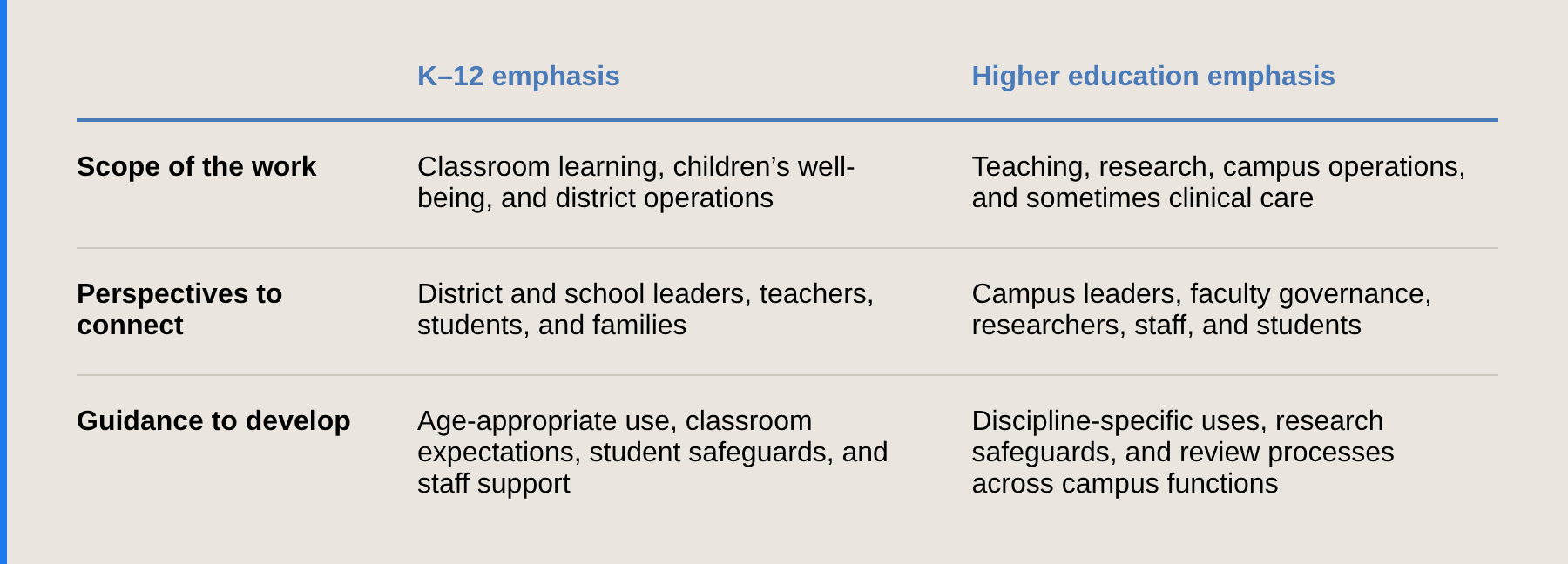

In K-12 settings, the training and values of staff and the school community are likely to play key roles in influencing concerns and decision making.

In higher education contexts, issues related to academic integrity, research viability and integrity, institutional compliance, including student and faculty input, and equitable access to AI tools for research and learning are likely to take center stage.
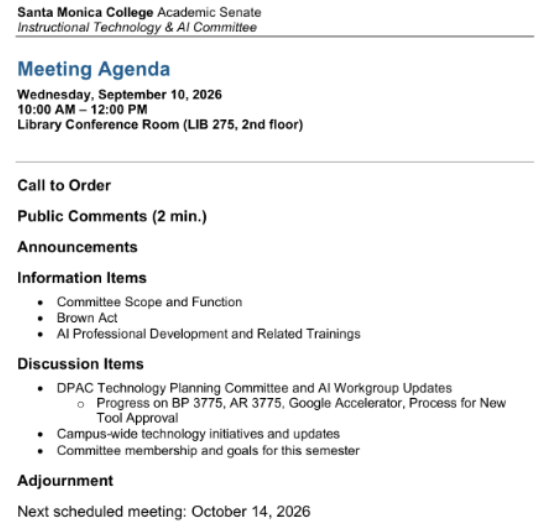
In both K-12 and higher ed settings, the challenge is to coordinate decisions while giving the people affected a meaningful voice.
In addition to adoption decisions for teaching and learning, AI council guidance can also support inquiry and review around the adoption of AI tools for operational functions.
For example, CoSN’s district resources address operational AI needs in areas such as finance, human resources, facilities, and cybersecurity.
3. Who Serves on AI Councils?
Obviously who’s on an AI council can and will vary from context to context. However, what’s worth noting is that “who’s on the council” should align with why the council exists.
For some people the obvious answer therefore is that IT team members, curriculum leads, and a finance department lead or designee, as well as instructional coaches will all participate on most AI councils.
However, inclusion and trust-building are also key. This means councils are likely to have participants representing and trusted by key stakeholder groups as well, including SPED teams, student reps, teacher union reps, and select community members with diverse backgrounds who give voice to important community perspectives.
Across participants, expertise should also be inclusive, with members fluent in technology alongside members who bring backgrounds in business and organizational leadership, health and welfare expertise, and even knowledge in areas such as human resource management, law, and social nonprofit leadership.
Indeed, councils don’t have to be limited to internal membership either. Having external partners with crucial advising insights can add immense value to how well the council serves its purpose. This means AI councils offer EdTech teams and educational nonprofits unique opportunities for developing or extending collaborative partnerships and conversations with a representative group of school or system stakeholders and leaders.
Having external partners with crucial advising insights can add immense value to how well the council serves its purpose. This means AI councils also offer EdTech teams and educational nonprofits unique opportunities for developing or extending collaborative partnerships and conversations with a representative group of school or system stakeholders and leaders.
K-12 councils should also bring instructional and operational perspectives together or provide advising for complementary teams.
Whether all the key stakeholders are on the AI council or distributed across teams with different decision-making and implementation roles, the idea behind the AI council approach is roughly the same: to include and coordinate the voices and efforts of teachers, learners, school managers, curriculum specialists, technology staff, and reps with insights from special education, finance, and human resources.
Higher education adds other relationships and responsibilities. For example, UC Davis’s model includes the participation of not only faculty and academic senate leaders, but also student representatives, research leads, administrative managers, privacy and technology specialists, and staff with roles in library and information services.
Student, family, and community participation also deserve deliberate attention. However, having a bloated and potentially unwieldy council structure is not the only option. Instead, the body can be much smaller as long as it sees itself as actively pursuing engagement. This can include ensuring highly accessible listening sessions public feedback forums or surveys and consultation with affected groups and with representatives of key interest or stakeholder groups.
External experts can contribute valuable consulting perspectives as well. To ensure transparency and trust, their involvement may call for providing clear disclosures about the limits of their consulting role and any potential commercial interests.

For participation to be effective, the process should include:
Broad representation and accessible opportunities to contribute
Shared dialogue norms that welcome disagreement
Clear leadership commitments about how council work informs decisions
Input that comes early enough to influence the choices under consideration
Responsive, two-way communication between advisers and decision-makers
An inclusive council needs more than a varied membership list and rubber stamps. It needs norms and guidelines that foster participatory and evidence-based deliberations, it needs meaningful agency, and needs to engage responsively with a broad cross-section of constitutents and stakeholders.
An inclusive council needs more than a varied membership list and rubber stamps. It needs norms and guidelines that foster participatory and evidence-based deliberations, it needs meaningful agency, and needs to engage responsively with a broad cross-section of constitutents and stakeholders.
4. Do AI Councils Primarily Vet Adoption Decisions, or Do They Have Broader Functions?
It’s easy to imagine AI councils primarily vetting tools, voting on purchases, and approving deployments. For education providers, that might suggest that getting a product into a school or university depends on winning over council members.
In reality, however, their authority depends on their charge and their relationship to existing leadership. Purchasing and adoption actions also involve budget, procurement, instructional, and technical reviews that extend beyond a single committee.
Some councils may have delegated approval authority. Others will influence decisions through recommendations, shared learning, and the development of policies governing AI uses and safeguards. If you’re an EdTech or nonprofit leader seeking to partner with AI councils, understanding this distinction is key to building a constructive and enduring partnership.
Their advisory work can also happen at different stages. A council might help leaders frame priorities before a proposal takes shape, bringing community concerns and educational needs into the conversation early. Or it might review a proposed adoption, identifying questions, risks, and conditions that deserve further attention.
In either case, a council can shape which problems leaders prioritize, what evidence they request, and whose perspectives inform the outcome.
Across these roles, councils can contribute by:
Setting direction: clarifying institutional goals and which uses warrant caution or exclusion.
Coordinating resources: identifying opportunities for shared tools, support, and investment.
Building understanding: helping educators, staff, and students assess AI’s capabilities and limitations.
Supporting public deliberation: explaining recommendations and inviting questions and differing perspectives.
Revisiting decisions and policies: responding when evidence, tools, or institutional needs change.
For teams or leaders eager to partner with educators and their organizations, the practical question is how the AI council shapes institutional planning and policy and nourishes change capacity — and how your expertise can contribute to that work.
For teams or leaders eager to partner with educators and their organizations, the practical question is how the AI council shapes institutional planning and policy and nourishes change capacity — and how your expertise can contribute to that work.
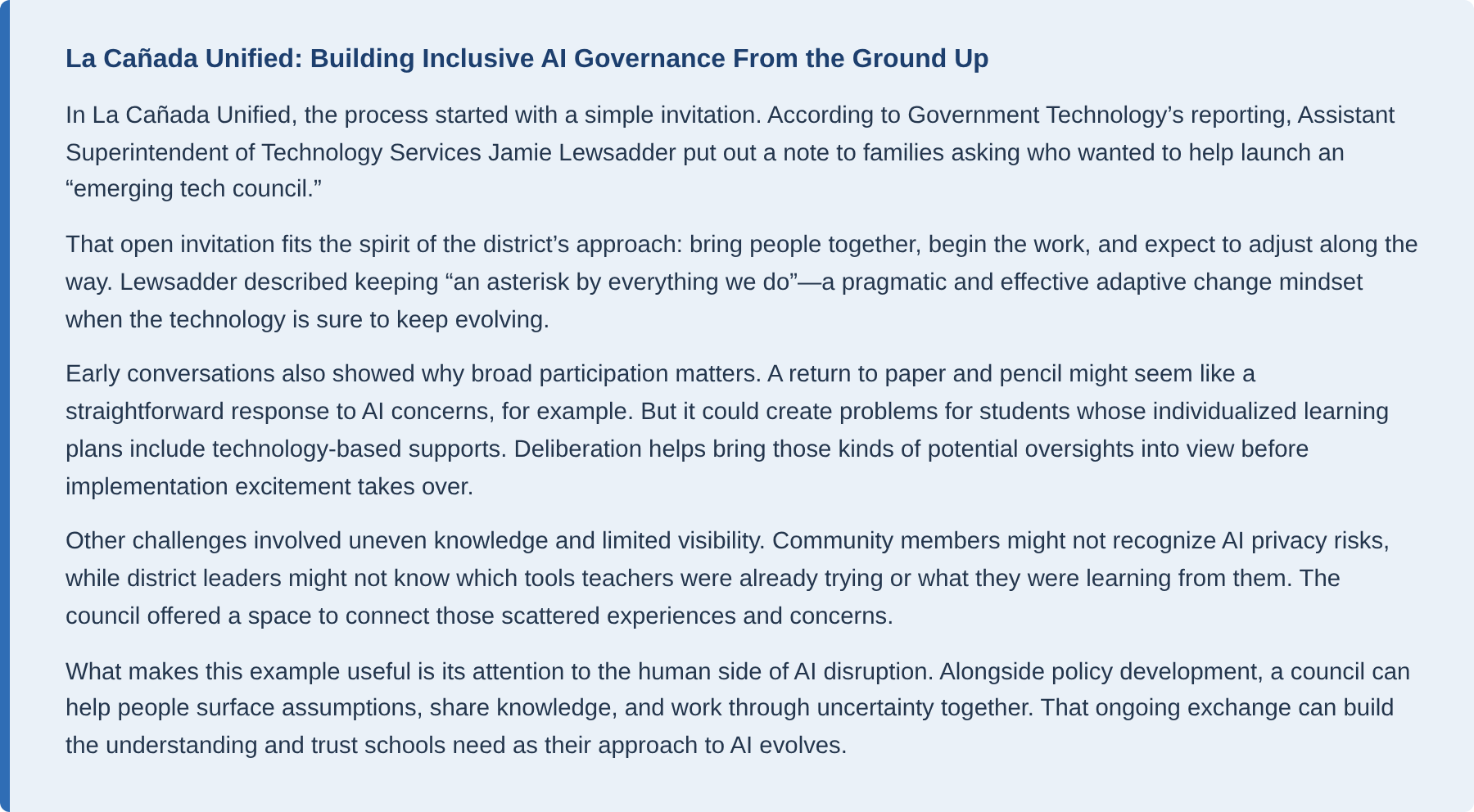
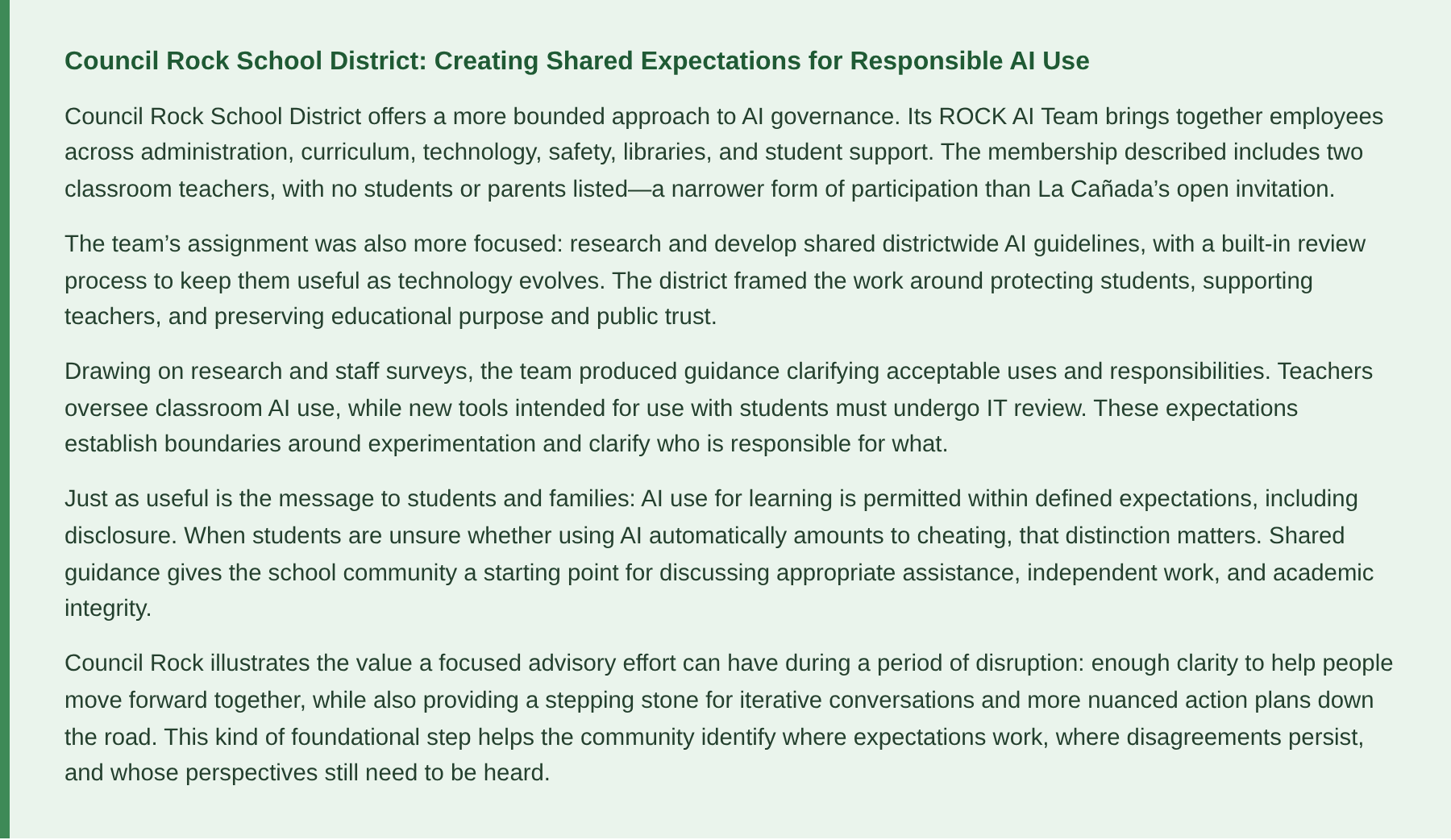
School Spotlights: La Cañada and Council Rock School Districts
5. What Best Practices Should Guide How AI Councils Support Schools?
There is no universal council rulebook, but the challenges councils address — and the examples explored above — suggest several practices for making councils purposeful, inclusive, and effective.
Here’s a list of some best practices leaders and advocates should consider when founding, improving, or reorienting a council charter:
Define the purpose and authority. Identify the challenges the council will address, what it can recommend or decide, and how it connects to existing leadership. Specify the resources it needs. A clear charge gives members direction and helps the community understand their role.
Choose a workable structure and allow it to evolve. Begin with a focused assignment and timeline, or establish an ongoing forum for emerging questions. La Cañada and Council Rock illustrate these different starting points. Either approach needs clear expectations and room to adjust as experience grows.
Make participation meaningful. Include instructional, technical, operational, and community perspectives. Give students, families, and staff accessible, safe ways to contribute through membership, listening sessions, surveys, or feedback. Invite input while questions remain open, and show participants how their perspectives influence the work.
Build a shared foundation for deliberation. Members bring different knowledge, experiences, and concerns. Make time for learning, examining evidence, and questioning assumptions. Welcome disagreement, with shared expectations for distinguishing demonstrated benefits from preferences, predictions, and promotional claims.
Make the work visible and accountable. Regularly communicate the council’s purpose, membership, and opportunities to participate. Share recommendations, reasoning, and unresolved questions. Explain how leaders respond and how the work informs subsequent decisions. Disclose relevant external relationships so participants can assess potential conflicts of interest.
Monitor and review the council’s effectiveness. Check whose perspectives are missing, whether recommendations reach decision-makers, and whether the work addresses school priorities. Ask participants how the process is working rather than assuming it has their trust. Use what you learn to revisit membership, scope, and procedures.

Attention to these practices can strengthen AI decision-making all while fostering a culture of listening and learning. Over time, that culture helps school communities work through uncertainty and develop the trust needed to move forward together.
AI councils guided by best practices can strengthen AI decision-making all while fostering a culture of listening and learning. Over time, that culture helps school communities work through uncertainty and develop the trust needed to move forward together.
6. Why Does the Advent of AI Councils Matter — for Grant Funding Seekers, Nonprofit Education Partners, and EdTech Companies?
In many settings and contexts, AI councils can offer education partners an exceptional window into the layered and complex considerations and institutional pressures guiding or constraining adoption initiatives and decisions. Partnering with AI councils is one exceptional way EdTech or nonprofit representatives can better understand:
what institutional needs are most pressing
what specific and urgent concerns their communities want addressed
what potential limiting beliefs, misconceptions, or objections are impacting decision-making processes
what knowledge gaps or logistical complexities are hindering planning or decision making
what kinds of ongoing systemic challenges constrain adoption efforts
Even when councils don’t control funding or contracts, their work can uncover granular insights that allow vendors or nonprofit partners to build stronger proposals and more relevant communications.
Even when councils don’t control funding or contracts, their work can uncover granular insights that allow vendors or nonprofit partners to build stronger proposals and more relevant communications.
For grant funding seekers
Council discussions and guidance can help grant seekers understand not only what makes a project uniquely promising but also what kinds of capacity needs and other conditions have to be addressed for achieving the greatest possible impact.
Get deeper and nuanced insights into documented needs for crucial priorities such as professional learning, equitable access, and evaluation designs — to strengthen a proposal’s rationale and bring to the fore the strength of your organization’s planning acumen and project commitments.
Identify which stakeholders or directors need to offer input, support, and approval as the grant proposal is developed.
Provide better informed accounting for grant budgets and cost projections — for training, staff time, technical support, and evaluation needs — so you and those scoring your grant are highly confident that the proposed activities fit the local setting and its unique needs and contours.
For EdTech companies, other vendors, and nonprofit leaders
Council activity can reveal challenges or questions that product descriptions and sales presentations may fail to address.
Connect your offering to specific educational needs, with clear evidence and answers about privacy, accessibility, limitations, and oversight.
Offer useful research, understandable explanations, and realistic pilot plans. Give educators room to assess the fit.
Listen for implications beyond the sale that may suggest changes to product design, implementation support, or messaging — such as questions about workload, student agency, or community trust.
For vendors and nonprofit leaders, this is an opportunity to make case studies, research briefs, and proposals more useful to the people weighing a decision. Explain what worked, under what conditions, and what remains uncertain.
Across both grant writing teams and vendors, pay attention to how school communities define the problem before presenting your solution. AI councils can make those conversations more visible — and help education partners contribute with greater relevance and credibility.
Moving beyond “embrace it” or “ban it” takes shared inquiry, room for disagreement, and decisions people can understand and revisit.
Education partners who understand how to navigate not just the logistics of technology adoptions but also crucial adaptive leadership practices will be better positioned to earn trust, avoid organizational stasis and polarization, and manage change pressures and iterative change processes — even in today’s disruptive AI era and against the backdrop of heightened public scrutiny over what AI is good for, what it means for teaching and learning, and the promises and risks it poses for future generations.
Four Background Sources for Further Reading
New York City Public Schools: AI Guidance Announcement
A K–12 example connecting advisory work, use boundaries, and community consultation.UC Davis Chancellor’s AI Council: February 2025 Report
A detailed discussion of proposed governance, training, and coordination. The document carries draft and deliberative markings.CoSN: Artificial Intelligence in K–12 Education
Resources for district readiness, shared leadership, and instructional and operational planning.Digital Promise: EdTech Procurement Framework—Sustain and Scale
A practical companion on connecting pilot evidence, community participation, and sustained implementation.
Taking the next steps…
If you’re leading school teams or trying to win adoption of tools or programs that help educators succeed, understanding how educators approach adoption and navigate layers of technical and adaptive challenges can help you craft messaging that gets their attention.
This is where EdPro can help.
EdPro Communications, LLC is a boutique communications service provider founded by Keith Nickolaus, PhD.
Keith combines over 16 years of education sector experience with up-to-date marketing and messaging best practices to help small and mid-size business and nonprofits craft smarter communications for a stronger education market presence.
Ready to get started?
—> Learn more about EdPro Services
—> Schedule a free 15-minute Discovery Call
EdPro serves only a small number of clients in order to provide reliable and tailored support — helping clients identify their most pressing communications challenges across the customer journey and delivering tailored messaging to address those challenges.