Demystifying Education Funding for Education Marketers
Whether you’re approaching adoption by engaging frontline educators as champions, or you’re talking to heads of schools, purchasing leads, or IT directors, you’re likely to find that the question “what’s in the budget?” has no straightforward answer. And, the overall size of a district or school budget can also be a poor indicator of the spending power that matters for your organization’s specific service, product, or offering.
In this post, we’ll try to demystify some of the most common complexities of school finance, so you can talk smarter with school prospects — understanding the rudiments of how funding sources, funding formulas, funding priorities, cost-object accounting, and funding cycles all add layers of complexity to purchasing processes and decision making.
Equally as important, understanding the ins and outs of school finance will give B2B marketers crucial insights into the funding challenges that complicate buying decisions — insights that will help you hone your marketing and messaging strategies and engage key decision makers.

How Education Funding Works
Understanding education finance begins with understanding that funding is layered, fragmented, and often constrained.
Education funding can look deceptively simple from the outside, but it’s made up of many different layers, often with different kinds of strings attached.
Public schools are funded by local sources, direct state revenues, and from federal education funding, including federal block grant funding that states distribute, and, for districts that compete for these, from competitive grant funding.
Public institutions of higher education will have similar funding layers, with colleges and universities relying on some combination of appropriations (for public institutions), tuition, research funding and research grants, other one-off or renewed grant funding, philanthropy, and endowment income.
These are the layers of funding, but there are also the strings that are attached…
A public school district may be managing state and local revenues with different statutory guidelines governing what the funds can be used for and not used for, how soon the funds must be spent, and whether unspent funds must be returned to public coffers or can be carried over into the next school year’s budget…
They will also have large funding streams tied to formula funding — some of which is available for general purpose operational expenses while other portions are earmarked for specific statutory priorities.
Much the same is true for any funding from competitive grants, as well. While some grant funds may come with fewer strings attached, most often competitive grant funding will be restricted to specific kinds of projects and programming with detailed spending rules and constraints that often vary from funder to funder and grant to grant.
Similar to other nonprofits, a nonprofit in the education sector might layer foundation support, government contracts, individual giving, and earned revenue, creating a patchwork of restricted and unrestricted funding with varied time frames and varied levels of sustainability and predictability.
All of this means that the size of an organization’s overall budget is only part of the story.
Other important questions will often include:
How much money resides in different revenue streams and budget allocations?
What can different budget allocation be used for? not used for?
Who controls it?
Does it renew or is it one-time funding?
If it renews, how dependable is it from year to year?
This explains why EdTech teams and other education B2B service and product providers should not think of their prospects’ overall budgets as a reliable indicator of spending capacity.
Spending restraints and controls, shifting budget allocations, short-term and longer term funding streams… All of these must be managed simultaneously by school leaders. In addition, these same leaders are often tasked with monitoring, measuring, documenting, and reporting on how funds are used and spent and the impacts that resulted.
EdTech teams and other education B2B service and product providers should not think of their prospects’ overall budgets as a reliable indicator of spending capacity.
Spending restraints and controls, shifting budget allocations, short-term and longer term funding streams… All of these must be managed simultaneously by school leaders. In addition, these same leaders are often tasked with monitoring, measuring, documenting, and reporting on how funds are used and spent and the impacts that resulted.
This is why, even when school leaders tell you they recognize the value of your offering, they may never adopt it. They may simply be unable to align your product, program, service or solution with current spending allocations or with prevailing schoolwide spending priorities. This may seem “irrational” from a business-sector perspective, but it’s a reality all to familiar to many school leaders, especially in publicly funded K-12 settings.
Understanding education finance, then, is less about following one stream of money than it is understanding an ecosystem of overlapping funding sources, restrictions, and priorities — all of which will vary and evolve differently in different school settings and contexts.
In other words, the complexities of school finance are just one more reason why there is so much variability across the K-12 market and your K-12 prospects. Different organizations operate within different funding ecosystems. This can directly affect their capacity to invest in various kinds of programming, services, staff, instructional technologies, or IT solutions.
More About Education Funding Sources
We’ve begun to spotlight the complexity of education sector revenue streams and budgets. Let’s dig a little deeper into some of the layered funding streams, such as state, local, and federal revenues.
The K-12 context
State funding plays a major role in determining how education dollars are distributed, while local revenue — often including property taxes — can significantly affect the amount of resources available within individual communities.
This means there is lots of variability — leading to both educational “disparities” and also variations in spending power across states, regions, districts, and local school sites.
Federal funding represents a smaller share of overall K–12 revenue, but it can be especially important for particular student populations, programs, or policy priorities.
If your organization provides effective programming, products, or services aligned with any of the federal programming priorities or with core high-need student populations, that can be an advantage for gaining adoption at more school sites. It may also open doors to opportunities to compete for grants for educational programming or for related child welfare and youth services — through federal agencies such as the U.S. Department of Education, the U.S. Department of Labor, or the U.S. Department of Health and Human Services.
Educational nonprofits
For many education nonprofits, unlike K-12 public schools or charter schools, budget size will typically be a more reliable indicator of spending power.
However, overall funding may be very limited, and the funding horizon more volatile, especially for the small and mid-size nonprofits that rely heavily on competitive grants.
Finally, if the nonprofit is flush with money from a large grant, the opportunity this money presents can depend very much on what the grant award was intended to be spent on.
For example, if won from an operating grant or capital projects grant, then the money will largely go to those purposes, though operational funding typically does allow for fairly wide spending discretion.
For programming and project-specific grant awards, even large ones, the purchasing or spend potential may be very limited if your offerings don’t align with the kind of programming and services the grant supports.
Finally, some nonprofits may rely at any given moment on money that not only has more or fewer spending restrictions, but also comes with clearly stipulated spending durations and implementation timelines. This can mean significant uncertainty when it comes to securing longer term funding, especially if the grant funding is not renewable, or if the renewable funding entails high measures of future uncertainy or high levels of future competition.
Funding complexity creates purchasing constraints
For organizations wondering which schools, districts, or education nonprofits have funding that can be used for the offerings or solutions they’re promoting, localized funding, budgeting, and spending variability can create persistent variability for sales teams and persistent budgeting challenges for school leaders.
In some cases, funding priorities will create strong opportunities for sales teams; in others, rigid and unfavorable constraints:
An education nonprofit considering a new literacy initiative, for example, may be able to pursue philanthropic or government funding, but with little certainty as to outcomes.
Sales teams and B2B firms will see quite different prospects across the education-sector market. Where one school district or school site may have funding streams, formulas, and priorities that align with their own organization’s offerings (creating a favorable selling opportunity), funding restrictions at other districts or sites severly limit the odds for adoption.
Grant seekers need to determine which of their current funding needs and priorities are most likely to dovetail with the legislative trends or earmarks influencing funding opportunities, and which do not. Likewise, grant seekers need to read the fine print in RFPs. For example, a health solutions enterprise may wish to partner with a university to gain grant funding to help the university pay for an effective SaaS product related to student mental health services. However, it may turn out, even when the grant targets the implementation of young adult mental health programming, that specific categorical spending restrictions apply, such as restrictions on equipment purchases as such or on SaaS products in particular, nullifying any value the grant would have for the purchase of the proposed IT product.
For EdTech companies and other B2B marketing teams, this also means adoption discussions and prospect messaging may often need to go beyond problems and solutions and needs and benefits — and include negotiated purchasing terms and conditions specific to localized funding and spending constraints, or potential grant funding opportunities and collaborations, or engaging school champions, relevant district leaders, or other key organization influencers in order to align change and spending priorities with the effective solutions you’re offering.
How K-12 Funding Formulas Shape Resource Allocation
Funding formulas often use a multiplier that factors in a weighted student count to set funding allocations.
As a result, funding amounts will not correspond directly to the number of students being served. They will be weighted — calculated according to the needs of the population served and governing policy priorities and statutory formulas in effect.
So, while it’s easiest to talk about public school financing and investment in terms of broad measures of average per-pupil funding, the factors that determine spending capacity for different kinds of offerings and initiatives tend to be much more variable and nuanced.
For example, public schools nationally in the U.S. received about $21,000 in revenue per pupil in fiscal year 2024. Average per-pupil spending on day-to-day operations was lower, however, about $17,600, as some revenues are dedicated for capital expenditures, such as school construction, and interest on debt.
National figures also hide wide-ranging differences in school-funding sources among states.
Nationally, K-12 funding distributions may amount to something approximating 43% local, 44% state, and 13% federal.
At the state level, funding distributions have significant variations, with local funding ranging from 2.0% to 61.7%, state funding from 29.5% to 85.4%, and federal funding from 6.5% to 24.0%, according to reporting by the Council of State Governments.
From a state-level perspective, spending power may seem far greater in some states compared to others as well. Using a random hypothetical to illustrate: Alabama spends about $13k per pupil, California closer to $21k. Let’s assume Alabama schools spend less on educator salaries due to a lower cost of living than California. This means Alabama may have a greater share of its smaller pool of funds available to spend on the adoption of educational products, programs, and services, relative to California.
Even more importantly, public education funding in different locales is rarely distributed on a simply per-pupil basis.
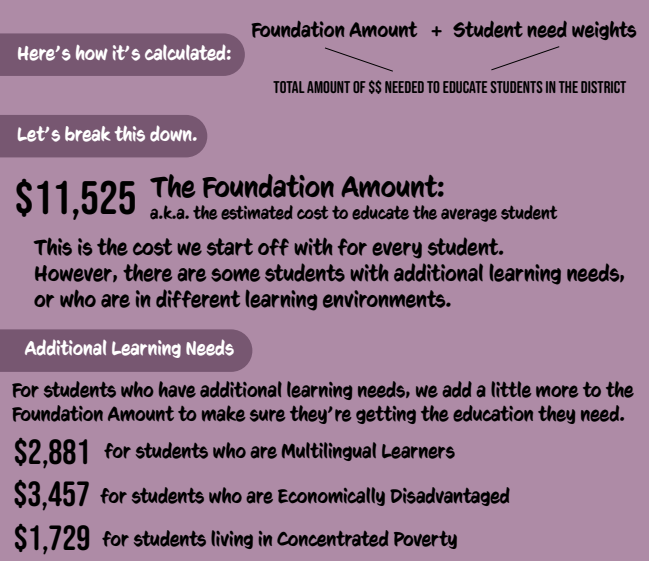
The foundational or “generic” per-pupil amount not only varies by state, but doesn’t reflect weighted factors that impact overall funding allocations and also the kinds of services a school may need to budget for.
For example, a state, region, or district with higher concentrations of English learners, special needs students, or under-resourced families and students, will earn additional funding to help them address those kinds of needs.
For example, in a state like California, there’s likely to be a bigger pot of funds dedicated to programming and adoptions that support multilingual learners due to the state’s disproportionate number of Latinx immigrants.
(Image credit: Excerpt from an infographic explaining Education Cost Sharing Formula, courtesy of the State of Connecticut.)
That the formulas themselves can become legalistic and technical is probably beside the point. What matters is understanding how these formulas and other funding complexities result in a complex or irrational marketplace when it comes to trying to predict spend capacity, spending priorities, and allocation sizes across local, regional, demographic, and even socio-political contexts or settings.
Funding complexities make for a complex or irrational marketplace when it comes to trying to predict spend capacity, spending priorities, and allocation sizes across local, regional, demographic, and even socio-political contexts or settings.
For example, two districts of similar size may operate with different funding levels or spending pressures because their student populations, local tax bases, or state funding structures differ.
Across regions, states, districts, and even across the same district, leaders may make allocation decisions that send more resources toward particular schools, populations, programs, or interventions — driven by imposed priorities or mandates, others by pressures exerted by local leaders, or by the will of a more inclusive stakeholder alliance.
For education nonprofits, these differences can help explain why partnership opportunities vary significantly from one community to another.
For product and service providers, they are a reminder that market size cannot be measured simply by counting schools or students and per-pupil revenues or spending — the financial capacity and the spending priorities, constraints, and mandates can differ, shift, and evolve considerably across different settings and time frames.
For grant seekers, funding formulas can provide important context, highlighting funding needs or gaps, or helping to demonstrate existing or emerging priorities and commitments.
The underlying idea is relatively straightforward: equal funding and equitable funding are not necessarily the same thing. Students and communities with greater needs may require additional resources to provide comparable educational opportunities.
The widespread adoption of foundation formulas stems from their practicality, offering states and districts an easily adjustable mechanism that balances educational objectives with economic realities… High-quality funding formulas aspire to be adequate and equitable but also flexible, adaptable, and predictable.
— “Decoding School Funding Formulas,” Council of State Governments
Priorities can also shift across time spans — such as year to year or decade to decade — in ways that may reflect broad national education policy trends, but also disparate state and regional trends and priorities.
For example, over the last five years, spending priorities in some states may have centered on adopting science of reading methods and related teacher training. In other states during the same time frame, leaders may have been guided by mandates for introducing other curricula, to champion climate education for example or to expand access to financial literacy instruction. As the new opportunities emerge, the same mandates or initiatives are also likely to restrict priorities that had enjoyed more robust funding in preceding cycles.
School Budgeting: Restricted, Flexible, Recurring, and One-Time Funds
The most important funding question is often not how much money is available, but what money is available for what purposes, under what conditions, and for how long.
Some funding is relatively flexible and can be used to support broad operating priorities. Other funding is restricted to specific purposes, populations, activities, or time periods.
Federal and state categorical funds, for example, may be tied to particular student groups or program goals.
Foundation grants may be awarded for a defined initiative and project time frame.
Capital funds may support facilities or infrastructure but not ongoing staffing or program costs.
For education leaders, this distinction is commonplace and a practical matter, not mere accounting jargon. A district may have millions of dollars in designated funding but find themselves unable to fund certain kinds of purchases or have enough funds available for a specific instructional initiative they would otherwise pursue.
A nonprofit may secure a large grant that covers expenses for direct program services but leaves little room for covering organizational overhead or equipment purchases — sometimes even equipment purchases related to the proposed services.
An EdTech provider may discover that a customer with a strong interest in the solution offered cannot use their existing budget to pay for it.
Grants and allowable uses
Competitive grants typically require applicants to make a case for funding, but even if an organization secures the grant, there may be lots of restrictions on how the money is spent.
Grants may also include other financial constraints — related to timelines, staffing, evaluation, procurement, documentation, matching funds, or reporting.
For schools and nonprofits, competitive grant funding can provide an opportunity to go after funds for specific initiatives they want to launch or expand and that would otherwise be difficult to finance. But grant seeking is likely to entail significant uncertainty:
grants aligned with your key initiatives may be few and far between, and come and go as funding trends evolve
grant cycles may be irregular
organizations may need to invest considerable time in project planning and proposal development with out any certainty about the funding outcome
For grant seekers, this means it can be hard to make confident projections about future funding, so that funds not-yet-procured under a clear spending framework cannot be allocated ahead of time, nor promised.
Recurring vs. 0ne-time funding
The distinction between recurring and one-time funding is equally important.
Recurring revenue can support ongoing commitments such as staffing, subscriptions, student services, and other operating costs. One-time funding may be much better suited to launch costs, equipment, infrastructure, implementation, pilot programs, or capacity-building investments.
When funding comes from a one-time grant or other source that isn’t renewable or may not prove renewable, it can be challenging to develop a plan for sustaining the initiative down the road:
A school may use short-term funding to add staff positions that become difficult to maintain once the funding expires.
A nonprofit may expand services rapidly through a multi-year grant without having a clear revenue source for the program afterward.
An institution might adopt a technology platform only to face an ongoing subscription cost that must later be absorbed into the operating budget.
For product and service providers, this can be consequential. For example, a customer may want to adopt a new product, program, or service, but concerns over how to pay for renewals, maintenance, training, or other ongoing costs can be a barrier to actual adoption.
Capital vs. operating funds
Funding can also be divided by the kinds of expenses it is intended to support.
Capital funding typically supports longer-term assets such as buildings, major renovations, infrastructure, or large equipment purchases.
Operating funds support the day-to-day costs of running programs and institutions, including staffing, services, supplies, and recurring expenses.
In some contexts funding for direct services — for key programming and service projects — may also be distinguished from general operating expenses that offer leaders greater spending latitude.
The distinction matters because funds available for one purpose may not simply be transferred to another.
A district may have a big pot of money for building a new computer lab — a capital expenditure. At the same time, limited instructional budgets may mean it’s unclear how they’ll pay for new instructional software once the lab is built. From the outside, this can look contradictory, if it’s even visible. From the perspective of those managing the education setting, it will be clearly understood that the two pools of money can only be used for specific kinds of expenditures.
Cost-object accounting and budget silos
Another feature of school district accounting is the prevalence of cost-object accounting, which channels operating revenues into distinct budget categories. This means efforts to fund new adoptions or initiatives typically come up against relatively rigid budgetary silos.
These silos constrain how monies can be spent or allocated, often with strict rules governing what funds can and cannot be moved from one category to another.
As for how much goes into each category, that too can be a complex process.
Common budget categories include:
Personnel and benefits (often representing the largest expenditure category)
instructional programs
student support services
special education
transportation
facilities
technology
compliance and administration
Sums allocated to specific categories are often held hostage there by contractual constraints that limit discretionary uses. Even when adjustments may be possible, the rules may be unclear, even for those inside the institution. For example, consensus building, compliance assessments, or procedural steps may be necessary — creating budgeting delays and uncertainty even if leaders are otherwise ready and eager to adopt your offering.
Sums allocated to specific categories are often held hostage there by contractual constraints that limit discretionary uses. Even when adjustments may be possible, the accounting rules may be unclear, even for some key decision makers. Consensus building, compliance assessments, or procedural steps may be a necessary first step to moving the funds — creating budgeting delays and uncertainty even if leaders are otherwise ready to adopt your offering.
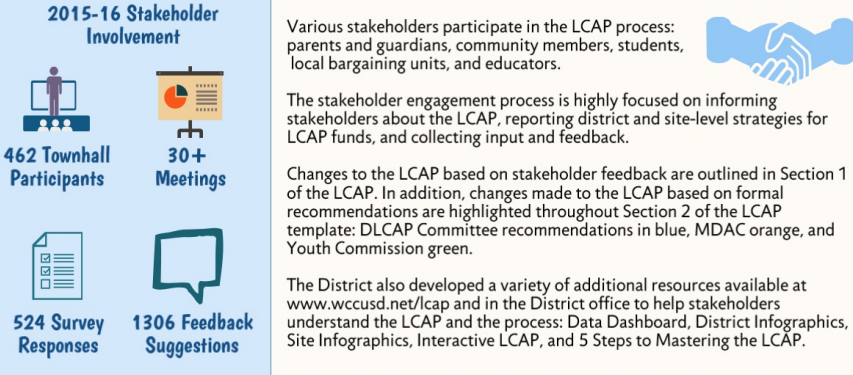
In addition to the funding formulas referenced earlier, many districts gather input on spending priorities for upcoming school years and budget cycles from diverse stakeholder groups — a process that may be a legal requirement in some districts.
The graphic on the right is excerpted from an infographic for West Contra Costa Unified School District (California), in conjunction with state-wide LCAP (Local Control and Accountability Plan) requirements that mandate an inclusive input-gathering process to guide budgeting decisions within a framework of key state education priorities and metrics, such as appropriately credentialed staffing, adherence to adopted content standards, school attendance rates, pupil suspension rates, and so on.
All of these layers of funding and budgeting complexity mean school leaders typically have far less discretionary flexibility than total budget figures may suggest.
This is an important reality for school providers, whether seeking to attain contractual partnerships, sell products, or build subscription revenues.
A school district may believe strongly in the value of a proposed offering or solution, but much of their money may be already earmarked for competing purposes or activities, or for specific student populations, and so on.
This means school leaders are often making spending decisions at the margins of their larger budgets — with the amounts of money they have discretion over being far less than what a marketing team might suppose based on overall budget size.
The Pursuit of Equity and Inclusive Governance
Education funding decisions are also never free of political pressures. After all, in school settings, spending decisions are viewed by school boards and those they serve as decisions about who gets access to resources, which needs receive priority, and whose perspectives shape those choices.
In practice, equitable funding does not mean distributing the same amount of money to every school, student, or program. Different populations may face very different barriers, and some may require additional resources to achieve comparable opportunities or outcomes.
Equitable funding does not mean distributing the same amount of money to every school, student, or program. Different populations may face very different barriers, and some may require additional resources to achieve comparable opportunities or outcomes.
For school systems, this can mean directing more funding toward students experiencing poverty, multilingual learners, students with disabilities, or to the schools serving communities with greater concentrations of need.
For education nonprofits, it may mean designing programs and funding strategies around populations that have historically had less access to educational opportunities or support.
But equity is not only about the final distribution of dollars. It also depends on professional norms that can vary across educational settings and contexts, norms that impact how spending priorities and decisions are formed…
While some school sites or school districts may have more top-down management structures and greater spending decision autonomy for top managers, many will be seeking to cultivate or adhere to more inclusive governance practices.
An inclusive approach aims to engage a wider spectrum of stakeholder input, deliberation, and consensus-building before setting big spending priorities and decisions. This often happens through advisory groups, public budget processes, needs assessments, community surveys or forums, participatory planning, or partnerships with organizations that have deep knowledge of the populations being served. Some of this activity may be ongoing, while larger goal setting efforts and broad strategic initiatives will typically grow out of intensive polling and consultation for direction setting with a multi-year horizon often ranging from 3 to 6 years.
This matters because financial decisions made without sufficient stakeholder input can miss important needs or result in investments that look sensible on paper but do not fit local realities or community interests. For sales teams thinking in terms of a quick close, all of this can be frustrating. In fact, it’s easy to discover that your sales campaign is well out of sync with a key cycle of strategic planning and purchasing. This is why deeper relationship building — and patience — may be a key strategy, alongside others, when it comes to building the kinds of partnerships that lead to meaningful and sustained adoption.
Levels of stakeholder support can also play a pivotal role in implementation depth and impact.
Not only winning adoption, but implementation success may also depend on or benefit from broad stakeholder interest and support. On the other hand, initiatives anchored only in top-down decision making may quickly lose support or suffer from weak or inconsistent implementation, only to wither on the vine.
When rank-and-file educators and the wider school community understand the benefits of key initiatives and get behind them, this can help accelerate and deepen implementation and help your offering deliver stronger results.
This means that building strong partnerships with K-12 prospects can be pivotal not just for closing a deal, but also for ensuring greater implementation support and success — successes that help you gain traction, credibility, and future adoptions.
Building strong partnerships with K-12 prospects can be pivotal not just for closing a deal, but also for ensuring greater implementation support and success — successes that help you gain traction, credibility, and future adoptions.
Likewise, an inclusive approach may also be pivotal for developing strong grant proposals. Both strategic plans and strategic funding proposal should show how priorities have been informed by the people and communities most affected and that implementation will include meaningful stakeholder participation and feedback.
For EdTech companies and other education-sector marketing teams, this is another reminder that adoption decisions are rarely based on product features alone. Solutions that align with institutional equity goals, respond to the needs of diverse users, and demonstrate that designs also factor in accessibility and inclusion may be better positioned to earn trust and support.
Building Sustainable Funding Models
For schools and other education institutions, sustainability starts with two practical questions:
Can we continue funding this initiative after the initial launch period ends?
How will we?
With exceptions for one-off projects, sustainability questions matter any time institutions adopt a new program, add staff, expand student services, or invest in new technology.

With exceptions for one-off projects, sustainability questions are likely to matter any time institutions adopt a new program, add staff, expand student services, or invest in new technology.
Effective leaders will look beyond the initial purchase or grant award and calculate recurring costs — for staffing, training, maintenance, implementation support…
In essence, purchasing decisions often entail more than just upfront costs. Someone in the organization should be looking to see if operating budgets can absorb the future costs or if there is an alternative approach to sustained financing.
If your sales team wants to take a partnership approach, you may be able to help school leaders come up with a flexible purchasing strategy. Common solutions can include:
starting with pilots before making larger commitments or phasing implementation over multiple budget cycles
identifying recurring funding sources early
integrating successful initiatives into core operating budgets (usually with by securing strong alignment with strategic goals or broad stakeholder interests and priorities)
gathering and exploiting outcome data to make a strong case for on-going or new funding
In the case of education nonprofits, sustainability often involves the challenge of building a diversified revenue base.
Many nonprofits will combine foundation and government grants, public contracts, corporate and individual giving, school or district partnerships, and sometimes earned revenue for this reason.
Likewise, it’s important for nonprofits to connect fundraising closely with program strategy, evidence of results, donor communications and outreach, and relationship building.
Why Understanding Funding Is Key for Engaging Your Prospects

For EdTech companies, consultants, curriculum providers, and other education vendors, understanding funding is a key part of understanding your prospects.
A school, district, college, or nonprofit may see a clear need for a product or service and still face significant constraints on whether, when, or how it can be purchased.
Available funds may be restricted to specific purposes, controlled by different departments, tied to a particular budget cycle, or available only for a limited period.
This means providers benefit from understanding a few basic questions early:
What funding streams might realistically support this type of purchase?
Are those funds flexible or restricted?
Who controls the relevant budget?
Is the funding recurring or temporary?
When are budget and planning decisions typically made?
What other priorities are competing for the same resources?
Can the customer sustain the investment after initial adoption?
These questions can shape both sales strategy and messaging. Stronger positioning connects an offering to the priorities customers are already funding — whether that means student achievement, educator capacity, operational efficiency, access, compliance, or another clearly defined need.
Evidence also matters. Schools and other institutions may need to justify new spending internally or as part of metrics they share with state leaders. This means providers can be in a stronger position when they can demonstrate outcomes, implementation feasibility, and a credible connection between the investment and the problem it is meant to solve.
The broader lesson is that funding complexity is not just someone else’s red tape to worry about. Funding hurdles and nuances can play a decisive role in which initiatives or adoptions get a green light, which partnerships gain traction, which programs scale, and which investments can be sustained over time.
This is why, for organizations selling into the education sector, understanding funding complexities is a key feature of understanding your prospects. Hopefully this blog post not only shows why, but offers actionable insights you can use as you develop your own communication and partnership-building strategies.
Taking the next steps…
If you’re leading school teams or trying to win adoption of tools or programs that help educators succeed, understanding the ins and outs of school finance and funding is a key factor for understanding and engaging your education-sector prospects and for delivering meaningful impacts.
This is where EdPro can help.
EdPro Communications, LLC is a boutique communications service provider founded by Keith Nickolaus, PhD.
Keith combines over 16 years of education sector experience with up-to-date marketing and messaging best practices to help small and mid-size business and nonprofits craft smarter communications for a stronger education market presence.
EdPro serves only a small number of clients in order to provide reliable and tailored support — helping clients identify their most pressing communications challenges across the customer journey and delivering tailored messaging to address those challenges.